

Cycle 13 Call for Proposals
Website
Proposal Deadline: 23 April 2026 15:00 UTC
The Call for Proposals for Cycle 13, which will run from 1 October 2026 to 30 September 2027, has now been announced. This will be the first cycle to offer Band 2 observations (with the 12-m Array only). The configuration schedule is available at this link. Also note that all observations during Cycle 13 will not be affected by the ongoing works related to the Wideband Sensitivity Upgrade.
For more information, see the announcement. If you would like help with proposal preparation, please contact the UK ARC Node for assistance.
Web-Based Observing Tool Released
The new web-based Observing Tool (OT) for Cycle 13 has now been publicly released and can be accessed from https://almascience.eso.org/proposing/observing-tool. This replaces the Java based OT that had been used in previous cycles, but it retains most of the original functionality. However, the web-based OT now automatically saves proposals online instead of locally, and it also allows multiple people to edit individual proposals.
If you would like assistance with using the web-based OT for proposal preparation, please contact the UK ARC Node.
First Images of the Central Molecular Zone from the ALMA CMZ Exploration Survey (ACES)
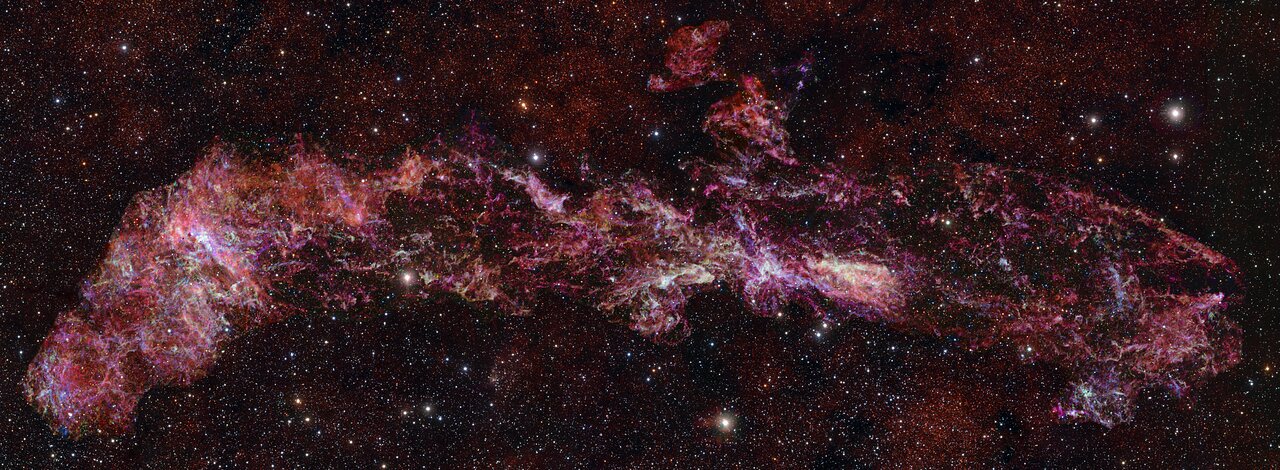
ALMA recently produced a press release exhibiting the first images from the ALMA CMZ Exploration Survey. Led by Steve Longmore at Liverpool John Moores University and supported by the UK ARC Node, this Large Program mapped the emission from multiple different molecular lines (including CS (2-1), HCO+ (1-0), and HNCO (4-3)) as well as the continuum within the central 100 pc of the Milky Way. The first set of papers from the survey have mapped in detail the filamentary structure of the Central Molecular Zone; separated sources of dust emission, free-free emission, and synchrotron emission; identified new linear parsec-scale absorption features traced by HCO+; measured continuum/line emission ratios and brightness ratios between pairs of isotopologue or
The data from the survey is online at https://almascience.org/alma-data/lp/aces. See the press release for more general information, or see the papers (I, II, III, IV, V, and VI) at ArXiv for details about the survey, the data products, and the scientific results.
Band 2 Science Verification Data Released
The first ALMA data from Band 2 have now been released to the astronomical community. These data include spectral scan observations of the high mass star forming region G31.41+0.31, the nearby ultraluminous infrared galaxy Arp 220, and the gravitationally lensed dusty star forming galaxy SPT 0027-50 as well as full polarization observations of the highly magnetized B2.5 main sequence star HR 5907. These data showcase how Band 2 can be used to observe new spectral lines as well as additional lower frequency ranges.
These and other Science Verification data can be accessed from the ALMA Science Verification Data page. The Band 2 data are numbers 23-26. Contact the UK ARC Node if assistance is needed with working with these data.
UK ALMA Regional Centre Support Information and Contact Details
The UK ALMA Regional Centre Node is available to provide support to people working with or interested in working with ALMA. This may include help with preparatory data analysis, including the use of archival data, proposal and observing preparation, data calibration and imaging, and subsequent data analyses. We can also provide computing facilities for ALMA data processing and training for individuals or groups of people.
If you have any ALMA science results that they want to share with the UK ALMA community, please contact us, and we will endeavour to include those results in our next newsletter and on our website.
For any ALMA-related queries or support requests, please contact the UK ARC Node via the following:
ALMA Helpdesk: help.almascience.org
Email: This email address is being protected from spambots. You need JavaScript enabled to view it.
Web: www.alma.ac.uk